CanSat 2024 Probe
Mission
The competition simulates atmospheric re-entry, protecting an egg (simulating sensitive equipment and samples) while taking measurements using a Pitot tube and sensors. The CanSat probe, whose mass must not exceed 0.9 kg, is launched as the nose of a rocket (provided by competition). With a controlled detonation, the probe separates from the rocket at its apex, and begins falling between 10-30 m/s using a specially designed aerobrake. Upon reaching 750 ft, the probe separates from the aerobrake and uses this to deploy a parachute, falling between 0-2 m/s. Rankings are determined by mission completition and design quality.
Design Overview
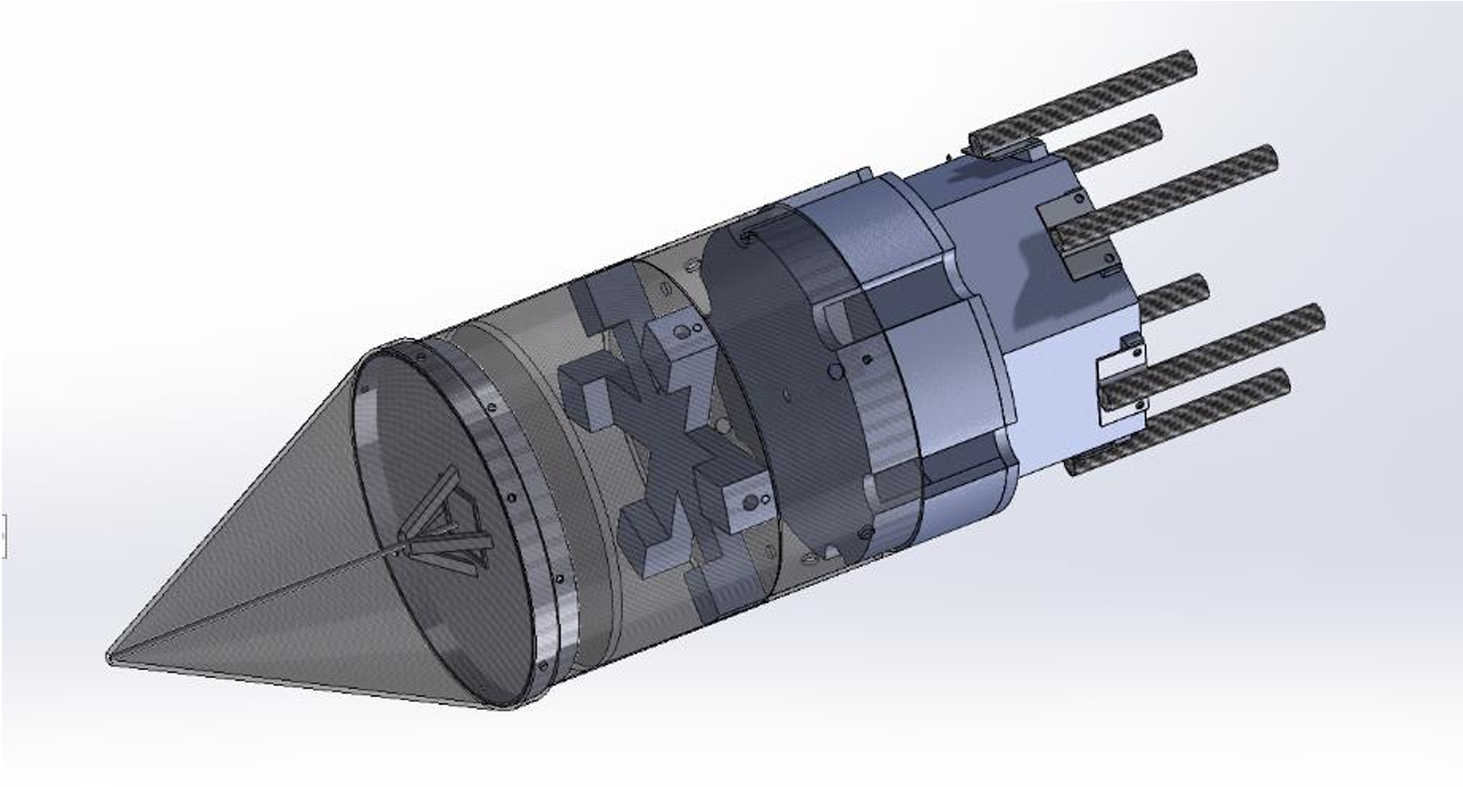
The payload was modeled in SolidWorks as a fully modular system, allowing rapid replacement and testing of nosecone, burn-wire deployment, electronics, and carbon‑fiber structural modules. The design emphasized low mass, high strength, and manufacturability.
Key Subsystems
1. Carbon Fiber Nosecone & Structural Modules
Used custom 3D‑printed molds to then hand craft carbon‑fiber nose cones. Manufactured and tested pointed and blunted nose designs, ultimately choosing blunt for its superior ability to withstand impact. This significantly reduced weight while maintaining strength and heat resistance.
2. Aerobrake and Burn‑Wire Deployment Mechanism
Integrated a two‑stage MOSFET + capacitor switching system enabling reliable deployment at low voltages (3.3–12V). Used burn-wire and spring system for rapid aerobrake release. Aerobrake was designed with carbon fiber support rods and fabric, calculating a surface area that ensured proper fall speed.
3. Overall Structure
Emphasized modular design to allow seamless integration of eclectic components. Designed and tested modules to optimize egg protection, electrical integration, and impact survivability.
Reports & Documentation
Outcome
Probe survived thermal testing and impact from over 3500 ft while staying below the 0.9 kg mass limit.
Team placed 38th of 100+ teams worldwide at the NASA & Lockheed Martin–sponsored AAS CanSat competition.